
Cost Guide · Updated 6 October 2026
Bathroom Renovation Cost in London (2026)
Planning a bathroom renovation across Greater London? This guide covers every cost tier, a real-world project breakdown, hidden London costs most guides miss, and what a trustworthy quote should include. For full service details and coverage, see Bathroom Renovation London. This guide is part of our full set of London renovation cost guides.
Quick Answer
A bathroom renovation in London costs between £3,500 and £22,000+ in 2026, depending on scope. A cosmetic refresh starts at £3,500–£5,500. A full mid-range renovation runs £8,000–£12,000. A wet room conversion costs £10,000–£16,000, and a high-specification finish reaches £14,000–£22,000+. London prices run 15 to 20 per cent above the UK national average, driven by higher labour rates and the complexity of period properties.
Sources: Checkatrade 2026 cost guide, MyJobQuote 2026 London labour data, MyBuilder 2026
Budget Tiers
Bathroom Renovation Cost in London by Budget (2026)
A bathroom renovation in London covers a wide range of scope and finish. The table below sets out what each budget tier typically delivers in 2026 for a standard 4–6m² London bathroom, including labour, materials and VAT. Prices reflect London rates, which run 15 to 20 per cent above the UK national average according to Checkatrade’s 2026 cost guide.
| Budget Tier | Total Cost (London 2026) | Scope of Work | Typical Property | Timeline |
|---|---|---|---|---|
| Cosmetic refresh | £3,500 – £5,500 | Like-for-like suite swap, re-grout or partial re-tile, no plumbing or layout changes. | Rental flats, quick pre-sale updates | 3 – 5 days |
| Mid-range renovation | £8,000 – £12,000 | Full strip-out and refit: new suite, full re-tile, plumbing reconnected, some layout flexibility. | Family bathrooms, Victorian terraces | 9 – 14 days |
| Premium / wet room | £14,000 – £18,000 | Wet room or ensuite conversion, tanking, underfloor heating, premium sanitaryware. | Modern flats, loft ensuites, accessibility needs | 12 – 18 days |
| Luxury bespoke | £18,000 – £22,000+ | Natural stone or large-format porcelain, freestanding bath, brushed brass brassware, bespoke joinery. | Chelsea, Fulham, Wandsworth high-spec homes | 14 – 22 days |
The 50/20/20 rule: Across most bathroom renovation budgets, labour accounts for roughly 50–60% of the total (MyBuilder, 2026), sanitaryware and fittings 20–25%, and tiling plus finishing materials 15–20%. The remainder covers waterproofing, waste removal and contingency. Use this ratio to sense-check any quote: if labour is well under 40% of a mid-range quote, ask what has been left out.
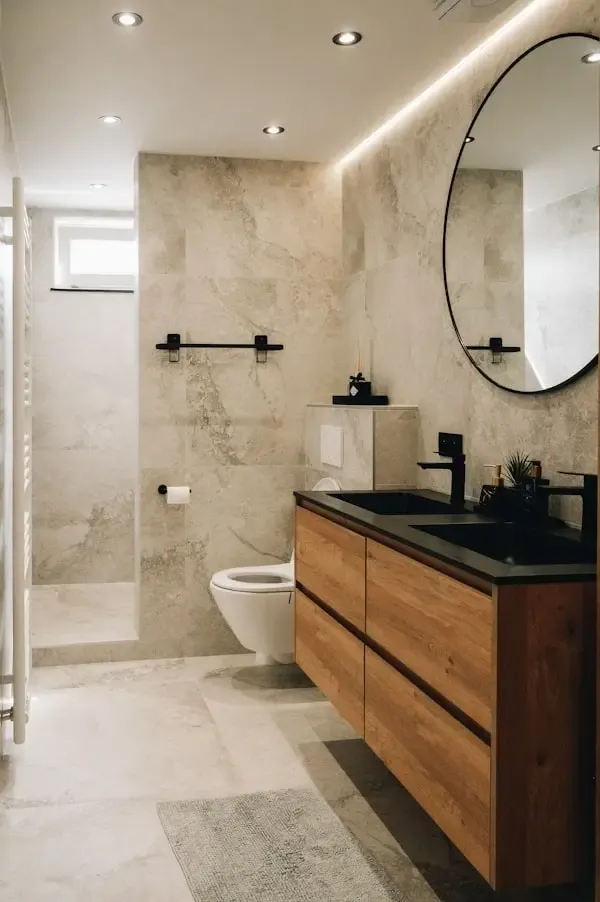
Premium / Wet Room Tier
A completed Soraiz Builders premium bathroom renovation: a walk-in shower, stone-effect tiling, and a floating oak and black vanity unit with a statement round mirror. This finish sits toward the top of the £14,000–£18,000 premium tier above.
Real Project · Southall, Ealing
What a Mid-Range Bathroom Renovation in London Actually Costs
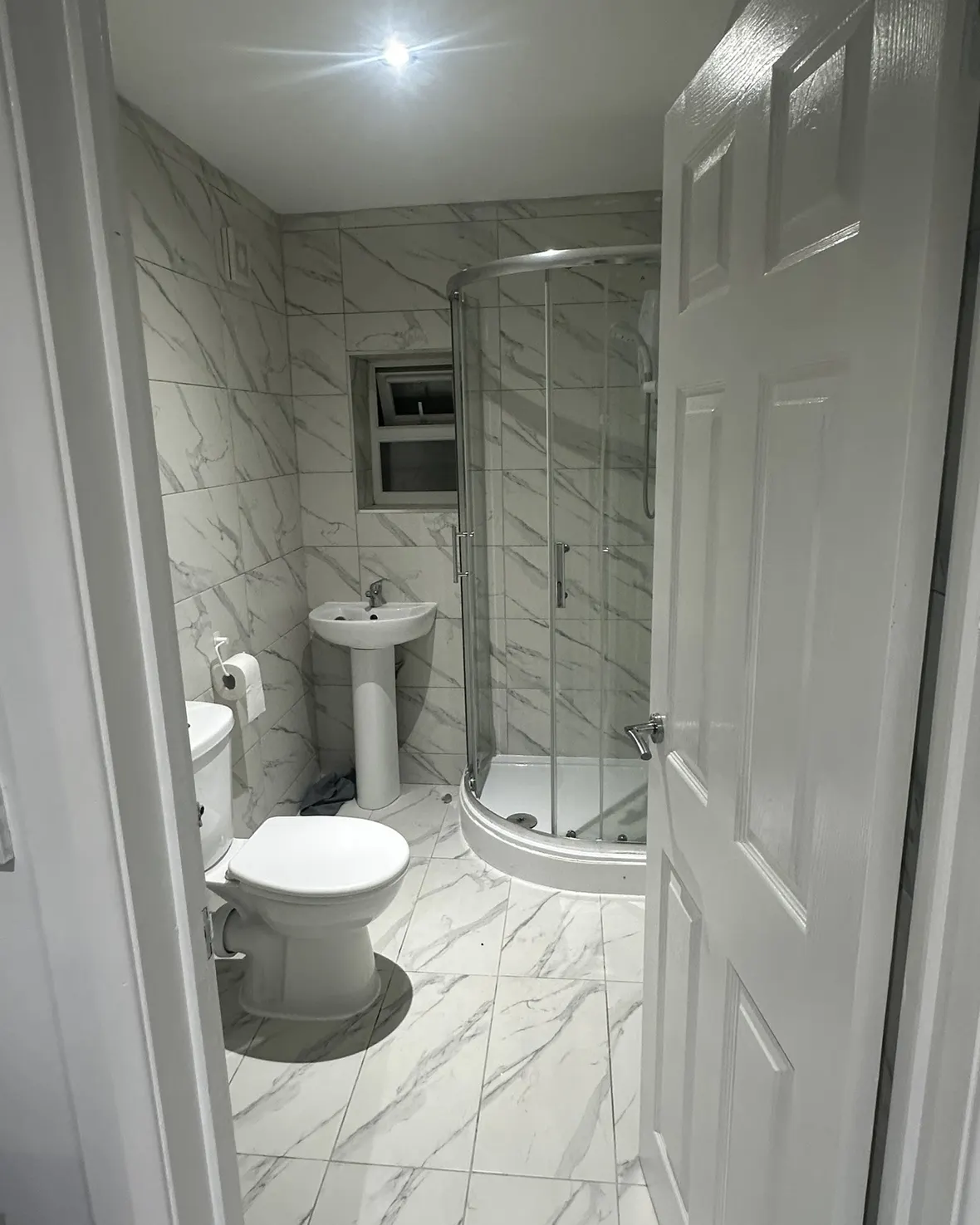
This completed Soraiz Builders bathroom renovation in Southall, Ealing shows where a mid-range budget goes. The cost breakdown below is a modelled mid-range scope built from the verified 2026 London cost data referenced throughout this guide, not an itemised invoice for this specific job. The scope: full strip-out, new suite with a quadrant shower enclosure, full re-tile, and the existing plumbing position retained.
Location
Southall, Ealing
Property type
Family home, West London
Bathroom size
Approx. 4.5m²
Layout change
None: existing plumbing position retained
Duration
10 working days
Total cost
£8,450
| Category | What was done | Cost |
|---|---|---|
| Strip-out | Removal of old suite, tiles and flooring, site protection | £480 |
| Sanitaryware suite | Close-coupled WC, pedestal basin, quadrant shower enclosure, tray and mixer valve | £1,750 |
| Tiling supply | Mid-range porcelain, 300×600, full-height walls and floor | £820 |
| Tiling labour | Tiler, 4 days, full-height wall and floor tiling | £980 |
| Plumbing labour | Reconnect WC, basin and bath, shower valve fit, isolation valves | £900 |
| Electrics | Extractor fan circuit, shaver socket, LED downlights, Part P certificate | £560 |
| Waterproofing | Tanking membrane to shower area and floor | £420 |
| Plastering and making good | Skim on two walls, ceiling made good after old boxing removed | £600 |
| Flooring detail | Waterproof LVT threshold and decoration, moisture-resistant paint, two coats | £470 |
| Consent & admin allowance | Budgeted allowance for consent administration where applicable (e.g. leasehold flats needing a licence to alter) | £550 |
| Waste removal | Skip hire and council permit | £320 |
| Contingency used | Old lead branch pipe found behind boxed-in pipework, replaced same day | £280 |
| Waste finishing | Silicone, sealants, final snagging | £320 |
| Total project cost | £8,450 | |
Figures are an illustrative model built from verified 2026 London cost data (see sources throughout this guide), not an invoice from a specific completed job.
London Premium
Why Bathroom Renovation Costs More in London
London bathroom renovations consistently run 15–20% above the UK national average, according to Checkatrade’s 2026 cost guide. Four cost drivers account for most of that premium.
Labour rates
London plumbers and electricians charge £280–£350 per day, and tilers £250–£300 per day. For a 9–14 day mid-range renovation involving three trades, labour typically represents 50–60% of the total budget.
Logistics and access
Skip hire and a council permit in London typically cost £200–£350, with some borough permits running as high as £260 for a 14-day placement. Non-compliant trade vans pay the ULEZ charge of £12.50 per day across Greater London, often reflected in day rates.
London property stock
Victorian and Edwardian terraces and conversions make up roughly half of inner London’s housing. Original lead supply pipes, found regularly during strip-out, cost £80–£120 per linear metre to replace when discovered.
Compliance and consent
Leasehold flats, common across London, need freeholder consent for plumbing and structural changes. A licence to alter typically costs £500–£2,500+ once administration and surveyor fees are included, and can take 4–8 weeks to approve.
| Trade | London day rate (2026) | Typical days on a mid-range job |
|---|---|---|
| Plumber | £280 – £350/day | 3 – 5 days |
| Tiler | £250 – £300/day | 3 – 5 days (full-height tiling) |
| Electrician (Part P certified) | £280 – £350/day | 1 – 2 days |
| Plasterer | £220 – £280/day | 1 – 2 days (if required) |
Sources: Checkatrade 2026 cost guide, MyJobQuote 2026 London labour data
Cost Breakdown
Bathroom Renovation Cost Breakdown: Where Your Money Goes
For a typical £9,000 mid-range London bathroom renovation, here is how the budget divides across each element. Use these percentages to reality-check any quote you receive, whether your project is larger or smaller.
| Category | % of Budget | Cost on £9K project | What’s included | London-specific note |
|---|---|---|---|---|
| Sanitaryware & fittings | 20% | £1,800 | WC, basin, bath or shower enclosure, taps, waste kits | Mid-range brands typical; premium brassware adds 30–50% |
| Tiling supply & labour | 22% | £1,980 | Wall and floor tiles, adhesive, grout, tiler’s time | Large-format porcelain adds £15–20/m²; herringbone or feature patterns add 20–40% to labour |
| Plumbing labour | 10% | £900 | Reconnection of WC, basin and bath, shower valve fit, isolation valves | Retaining fixture positions saves £600–£1,200 vs re-routing |
| Strip-out & waste removal | 8% | £720 | Removal of old suite, tiles and flooring; skip hire and council permit | Skip hire and permit run £200–£350 in most London boroughs |
| Electrics | 6% | £540 | Extractor fan circuit, shaver socket, LED downlights, Part P certificate | Part P certification is a legal requirement for bathroom electrical work |
| Waterproofing / tanking | 5% | £450 | Tanking membrane to shower and wet-area floors | Mandatory for wet rooms; strongly advised for any walk-in shower |
| Plastering & decoration | 12% | £1,080 | Making good walls and ceiling, two coats moisture-resistant paint | Victorian lath-and-plaster walls typically need more preparation than post-war plasterboard |
| Consent, contingency & management | 17% | £1,530 | Freeholder licence-to-alter fee where applicable, 10–15% contingency, fixed-price project management | Leasehold flats: budget £500–£2,500+ and 4–8 weeks for freeholder approval |
Red flag in a quote: If plumbing, tiling and electrics are bundled into a single labour line with no breakdown, ask for it itemised by trade. A reliable contractor separates plumber, tiler, electrician and plasterer into distinct line items, because these are different trades charging different day rates, and a bundled figure makes it hard to compare against other quotes or spot inflated markup.
Timeline
How Long Does a Bathroom Renovation Take in London?
A full mid-range bathroom renovation in London takes 9–14 days from strip-out to handover. A like-for-like cosmetic refresh runs 3–5 days, while a wet room or ensuite conversion takes 12–18 days because tanking and screed need curing time before tiling can begin.
3 – 5 days
Cosmetic refresh
Like-for-like suite swap, re-grout or partial re-tile. No plumbing or layout changes. Minimal disruption.
9 – 14 days
Full mid-range renovation
Full strip-out, new suite, full re-tile, plumbing and electrics reconnected. The most common scope in London.
12 – 18 days
Wet room / ensuite conversion
Tanking membrane and screed require curing time before tiling. Layout changes add sequencing between trades.
Can a bathroom renovation be done in stages?
Less easily than a kitchen. A bathroom needs to be watertight and usable as soon as work starts, so splitting a single renovation into a cosmetic phase and a structural phase later is rarely practical if it is the property’s only bathroom.
The more realistic way to spread cost is to reduce scope now and expand later: a like-for-like suite replacement today, with a wet room conversion or layout change booked as a separate project once the budget allows. Handled this way, each phase is a complete, usable bathroom in its own right.
Planning for disruption: If it is the only bathroom in the property, plan alternative arrangements for the 9–18 day window. A portaloo rental costs roughly £80–£120 per week, or arrange to use a neighbour’s or relative’s bathroom. Confirm this with your contractor before agreeing a start date: it is one of the practical details most quotes leave the homeowner to work out alone.
Property-Specific Costs
How Your London Property Type Affects the Cost
The era and tenure of your London property is one of the strongest predictors of where a bathroom renovation budget actually goes. A suite costs the same in Harrow and Islington, but pipework, consent requirements and access constraints differ significantly by property type.
Pre-1919
Victorian & Edwardian terraces
Common in Islington, Ealing, Wandsworth, Hackney and most inner London boroughs
Cost drivers to watch
- Lead and cast-iron pipework: Common in pre-1919 homes. Replacing a lead branch pipe when found during strip-out costs £80–£120 per linear metre.
- Lath-and-plaster walls: Need more extensive making good than post-war plasterboard before tiling, adding to plastering labour.
- Original floor joists: Heavy tiled floors may need joists sistered to carry the load, particularly for a wet room. Add £400–£1,000.
- Conservation area rules: Many Victorian streets in Islington and Wandsworth sit within conservation areas, which can affect external soil vent pipe changes.
1930s – 1970s
Semi-detached & terraced homes
Abundant in Harrow, Bexley, Sutton and outer London boroughs
Cost drivers to watch
- Asbestos risk: Original floor tiles and artex ceilings in homes built before 1985 may contain asbestos. A licensed survey before strip-out costs £150–£300; removal adds £500–£2,000 if found.
- Single-skin external walls: Can increase condensation risk if extractor ventilation is undersized. Budget for a correctly rated extractor fan, not the cheapest option.
- Straightforward waste runs: Generally simpler drainage layouts than period conversions, which can keep plumbing labour toward the lower end of the range.
All eras
Leasehold flats & mansion blocks
Common across all London boroughs: Victorian conversions, purpose-built blocks and modern developments
Cost drivers to watch
- Freeholder consent: Most leases require written consent before plumbing or structural changes. A licence to alter typically costs £500–£2,500+ once administration and surveyor fees are included. Allow 4–8 weeks for approval.
- Shared waste stacks: Work on a soil stack shared with other flats often requires advance notice to neighbours and the managing agent.
- Noise hours: Many leases restrict noisy work to weekday daytime hours, which can extend a project by a day or two versus a freehold house.
- Lift access: Upper-floor flats without a lift add to waste removal and material delivery costs.
Hidden Costs
Hidden Costs of a London Bathroom Renovation Most Guides Miss
Most budget overruns are not caused by expensive fittings. They come from costs that were never in the original quote. Here are six of the most common ones specific to London.
Freeholder consent (leasehold flats)
If you own a leasehold flat, your freeholder or managing agent may charge a licence-to-alter fee, typically £500–£2,500+ once administration and surveyor costs are included. Allow 4–8 weeks for approval: this affects your start date, not just your budget.
Skip hire and council permits
Skip hire and a council permit in London typically cost £200–£350, though permit fees alone vary from around £30 up to £260 for a 14-day placement depending on the borough. Confirm whether this is included in your quote before work starts.
ULEZ charges on trade vans
Non-compliant trade vans operating anywhere in Greater London pay £12.50 per day in ULEZ charges. Over a 9–14 day renovation with multiple trade visits, ask your contractor upfront whether this is absorbed or passed on.
Structural sign-off for wet rooms
A wet room adds weight and requires the floor structure to be checked, particularly in upper-floor flats. A basic structural inspection and report in London costs £400–£600, rising for more complex cases. This is rarely included in a builder’s quote unless specifically requested.
Alternative facilities if it’s your only bathroom
A portaloo rental costs roughly £80–£120 per week if the property has no second bathroom or shower. Some homeowners instead arrange to stay with family for the most disruptive days: either way, budget for it before work starts.
Contingency: use 10–15% in London, not less
Set aside 10% of the quoted price as contingency on any property built after 1970. For Victorian and Edwardian properties, which make up roughly half of inner London’s housing stock, 15% is more realistic. Lead pipework, rotten joists and subfloor damage are the most common discoveries.
Grants & Support
Bathroom Renovation Grants and Financial Support in London (2026)
The most relevant support for bathroom work is the Disabled Facilities Grant, which specifically covers accessible bathroom adaptations. Two further schemes can help where energy efficiency work overlaps with your renovation.
Accessibility
Disabled Facilities Grant (DFG)
Provides up to £30,000 in England for essential home adaptations, including level-access showers, wet rooms, walk-in showers and accessible toilets, where necessary for a disabled person in the household. The grant is means-tested for adults and applied for through your local council. Allow time for an occupational therapist assessment before work starts.
Energy Efficiency
ECO4 (Energy Company Obligation)
If your bathroom renovation involves upgrading an inefficient electric shower, heating element or insulation tied to the wider property, eligible low-income or benefit-receiving households may access funding through their energy supplier under the ECO4 scheme. Check eligibility via GOV.UK or your energy supplier.
Local Authority
Borough top-up funding
Some London boroughs administer the Disabled Facilities Grant locally and can offer discretionary top-up funding where the standard grant does not cover the full scope of an accessible bathroom. Contact your borough council’s housing or occupational therapy team directly to check current provision.
If none of these schemes apply to your project: the most effective protection against budget overrun is a fixed-price contract with a clearly specified, itemised scope. This is standard practice for Soraiz Builders on every London bathroom renovation.
FAQs
Bathroom Renovation Cost in London: Frequently Asked Questions
Answers to the questions London homeowners ask most when budgeting for a bathroom renovation, based on 2026 London market data.
A bathroom renovation in London costs between £3,500 and £22,000+ in 2026, depending on scope. A like-for-like suite replacement runs £5,500–£8,000. A full mid-range renovation costs £8,000–£12,000, and most standard family bathrooms fall in this range. A wet room conversion costs £10,000–£16,000. London prices run 15 to 20 per cent above the UK national average, driven by higher labour rates and period-property complications.
A full mid-range bathroom renovation in London takes 9–14 days from strip-out to handover. A cosmetic refresh takes 3–5 days. A wet room or ensuite conversion takes 12–18 days, because tanking and screed need curing time before tiling can start. The main variables are whether the layout is changing and how many trades need to be sequenced.
Less easily than a kitchen, because a bathroom needs to be watertight and usable throughout, so splitting one renovation into two phases is rarely practical if it’s your only bathroom. The more realistic approach is to reduce scope now, a like-for-like suite replacement, and book a wet room conversion or layout change as a separate project once budget allows. Each phase then delivers a complete, usable bathroom.
If you own a leasehold flat, most leases require written consent from the freeholder or managing agent before plumbing or structural changes, including moving a WC or shower. A licence to alter typically costs £500–£2,500+ once administration and surveyor fees are included, and can take 4–8 weeks to approve. Freehold houses generally do not need this consent unless the property is listed or in a conservation area with external changes involved.
The most commonly missed costs are freeholder consent fees (£500–£2,500+ for leasehold flats), skip hire and council permits (£200–£350), a structural inspection for wet rooms (£400–£600), and alternative facilities if it’s your only bathroom, around £80–£120 per week for a portaloo. Set aside a 10–15% contingency for period properties, where lead pipework and subfloor damage are common discoveries.
Yes. The Disabled Facilities Grant (DFG) provides up to £30,000 in England for essential adaptations, including level-access showers, wet rooms and walk-in showers, where necessary for a disabled person in the household. It is means-tested for adults, applied for through your local council, and usually requires an occupational therapist assessment before work is approved. Some boroughs offer discretionary top-up funding for cases the standard grant doesn’t fully cover.
In 2026, London plumbers and Part P certified electricians charge £280–£350 per day, and tilers £250–£300 per day (Checkatrade, MyJobQuote 2026 London labour data). A plasterer runs £220–£280 per day where required. Always ask for labour itemised by trade rather than a single bundled figure, so you can compare quotes fairly and confirm what each day rate covers.
A wet room conversion in London costs £10,000–£16,000, roughly £2,000–£4,000 more than a full mid-range renovation at the same size. The premium covers a gradient screed, tanking membrane, linear drain and, in upper-floor flats, a structural check on the floor. Curing time for the screed and tanking also extends the timeline by 3–4 days compared with a standard renovation.
About the Author
Shamraiz Hussain founded Soraiz Builders in 2019, bringing a background in electrical engineering and 7+ years in London trades. Since then, Soraiz Builders has completed 250+ projects across all 32 London boroughs, maintaining a 5.0-star MyBuilder rating from 23 verified reviews. Read more on the full author page.
Get Your Bathroom Quote
Free Bathroom Renovation Quote: Response in 2 Hours
Soraiz Builders has completed bathroom renovations across all 32 London boroughs since 2019. Send us your bathroom size, preferred scope, and postcode, and we’ll come back with a free, itemised quote within 2 hours. No obligation, no vague estimates.
What drove this project’s cost
Retaining the existing plumbing position saved an estimated £600–£1,200 compared with moving the WC to a new wall, the single biggest lever on a bathroom renovation budget. This is the first question raised at every Soraiz site survey, because moving a soil pipe even 30cm can add a full day of plumbing.
The modelled budget above sets aside £550 and roughly 4–8 weeks of lead time for consent administration, because leasehold flats across London routinely need a freeholder’s licence to alter before plumbing or structural work can start. It’s a cost and a timeline factor that owner-occupied freehold houses generally do not face, so always confirm your own property’s tenure before finalising a start date.
The modelled scope also allows for an unplanned item: an old lead branch pipe found behind boxed-in pipework during strip-out, a common discovery in older London properties. Flagged the same day with a written cost update before replacement, it adds £280 to the total. The modelled renovation lands at £8,450, comfortably inside the £8,000–£12,000 mid-range tier, because the layout stayed the same and no wet room conversion was needed.