
Builders in Hackney: Extensions, Loft Conversions & Renovations in E5, E8, E9 & N16
Soraiz Builders carries out extensions, loft conversions, renovations and full-trade building work across Hackney, from the Georgian terraces of De Beauvoir Town to the converted warehouses of Hackney Wick. Hackney Wick and Shoreditch's former Victorian factories and warehouses have been converted into flats and live-work units with original cast-iron columns, shared freehold structures and often no cavity wall at all, a genuinely different building type to the borough's Georgian and Victorian terraces. Call Shamraiz Hussain's team today and get a written quote within 2 hours.
Soraiz Builders provides extensions, loft conversions, renovations, plumbing, electrics and full building work across Hackney, including Dalston, Stoke Newington, London Fields, Clapton and Hackney Wick. Hackney has 36 conservation areas and sits on gravel and brickearth rather than clay, which changes how extensions and conversions get planned. Soraiz Builders offers a written quote within 2 hours of enquiry.
Hackney has more than 1,300 listed buildings across its 36 conservation areas, and Sutton House in Homerton, dating from 1535, is the oldest surviving house in the borough.
We respond within 2 hours during business hours.
Housing Stock by Area
What kind of houses does Hackney have?
Hackney is denser and more architecturally mixed than most London boroughs, and its housing stock reflects a history of rapid Victorian growth followed by a much more recent wave of industrial conversion.
- De Beauvoir Town and Clapton Square (N1, E5): Georgian terraces and stuccoed villas, some of the borough's oldest surviving housing, several individually listed.
- London Fields, Hackney Downs and Dalston (E8, E5): Victorian terraces make up the bulk of the borough's homes, tightly packed streets with the shallow foundations typical of that era.
- Upper Clapton and Stoke Newington (E5, N16): a mix of Edwardian semis and Victorian terraces, with Stoke Newington's Tudor-revival buildings adding another distinct layer.
- Hackney Wick and Shoreditch (E9, E2): former Victorian factories and warehouses converted into flats and live-work spaces, a genuinely different building type from anything else in the borough. More on this below, since it changes what a renovation actually involves.
- Post-war estates: found across the borough, many now undergoing redevelopment or partial renewal.
Warehouse and live-work conversions in Hackney Wick and Shoreditch
A meaningful share of Hackney's housing stock didn't start as housing at all. Hackney Wick was a working Victorian industrial suburb, and its factories, print works and canal-side warehouses have been converted into flats, studios and live-work units over the past two decades. These properties come with a different set of problems to a Victorian terrace: original cast-iron columns and steel beams that can't simply be cut into, shared freehold structures with other converted units, party structures that don't follow a normal terrace's simple shared-wall logic, and often no cavity wall at all, just solid brick or concrete that needs a completely different approach to insulation and damp control. We treat a Hackney Wick conversion as its own category of job, not a flat that happens to be in an old building.
Common problems we see in Hackney properties
Hackney's ground conditions are genuinely different from most of London, and it's worth knowing this before any structural work starts.
- Hackney sits on gravel and brickearth, not surface clay: most of London's subsidence stories are about London Clay shrinking and swelling with the seasons. Hackney's surface geology is different, a layer of Hackney Gravel and brickearth sitting over the clay rather than the clay itself being at the surface. Brickearth in particular can be firm and stable in one spot and, in places with a more open structure, prone to sudden settlement if it's overloaded or gets wet under load. It is not a reason to worry, but it is a reason to get the ground checked properly rather than assume the standard London Clay advice applies here.
- Solid walls and non-standard structures in converted buildings: a Hackney Wick or Shoreditch conversion often has no cavity wall, and sometimes no conventional foundation in the way a Victorian terrace would. Retrofitting insulation or running new services needs a different method to a normal house.
- Party wall and party structure complexity: Victorian terraces need a standard Party Wall Agreement for most rear extensions, but converted warehouse units often share a freehold or a management company with several other flats, which adds a layer of consent that a straightforward terrace extension doesn't need.
- Canal and waterside proximity in Hackney Wick: properties close to the Regent's Canal or the River Lea occasionally raise drainage and damp questions that inland Hackney properties don't have, worth checking rather than assuming.
Local Area
Local landmarks and transport links relevant to building work in this area.
- Sutton House, Homerton High Street, E9
- Hackney Empire, Mare Street, E8
- Victoria Park, E9
Hackney Central (London Overground), Hackney Downs (London Overground and National Rail), London Fields (London Overground), Homerton (London Overground), Dalston Kingsland (London Overground)
Where We Work in Hackney
Where we work in Hackney
We cover the whole borough, E5, E8, E9, E20, N1 and N16, including:
- Dalston and Kingsland (E8, N1, N16): the Kingsland Conservation Area and Dalston's dense mix of Victorian terraces and newer infill, close to Dalston Kingsland station.
- De Beauvoir Town (N1): Georgian and early Victorian squares, one of the borough's most tightly managed conservation areas.
- London Fields and Broadway Market (E8): Victorian terrace streets around the park and the Saturday market, inside the Broadway Market Conservation Area.
- Stoke Newington (N16): Georgian and Victorian streets around Clissold Park and Church Street, with several conservation areas including Clissold Park and Stoke Newington itself.
- Clapton, Upper and Lower (E5): Victorian terraces around Clapton Square and Clapton Common, among the borough's original 1969 conservation areas.
- Hackney Central and Homerton (E8, E9): the historic centre around Mare Street and the Hackney Empire, home to Sutton House, the oldest house in the borough.
- Hackney Wick and Fish Island (E9, E3): former Victorian industrial streets, now converted warehouses and live-work units bordering the Queen Elizabeth Olympic Park, with major redevelopment still ongoing at Fish Island Village and East Wick.
- Victoria Park fringe (E9): Victorian terraces around the 86-hectare park itself, inside the Victoria Park Conservation Area.
Working around Hackney's parking and access
Much of Hackney operates Controlled Parking Zones, particularly around Dalston, London Fields and Hackney Central. Any skip on the public highway needs a council skip licence, and if it's going inside a CPZ that needs at least 7 working days' notice before the licence starts, or 3 days outside one. We arrange builder's parking permits and skip licences in advance so materials and skips don't sit waiting on day one.
Check If We Cover Your Hackney Street
Get a Free QuotePlanning & Conservation
What to check before starting building work in this borough.
London Borough of Hackney (Hackney Council)
Planning portal: View planning permission information
Planning permission and conservation areas in Hackney
Hackney has 36 conservation areas, more than almost any other London borough for its size: Albion Square, Beck Road, Broadway Market, Brownswood, Clapton Common, Clapton Pond, Clapton Square, Clissold Park, Dalston, Dalston Lane (West), De Beauvoir, Fremont and Warneford, Graham Road and Mapledene, Hackney Road, Hackney Wick, Hoxton Street, Kingsland, Lea Bridge, Lordship Park, Mare Street, Newington Green (North), Northwold and Cazenove, Pitfield Street, Queensbridge Road, Regent's Canal, Shacklewell Green, South Shoreditch, St Mark's, Stoke Newington, Stoke Newington reservoirs and filter beds, Sun Street, Town Hall Square, Underwood Street, Victoria Park and Well Street. With over 1,300 listed buildings across the borough, a large share of Hackney addresses fall inside one of these boundaries.
Before planning any external work in Hackney, check your address on Hackney Council's planning portal to confirm your conservation area status. We do this on every Hackney quote as standard, since the odds of a property being inside one of the 36 areas are genuinely high here.
Ground conditions: why Hackney needs a different structural approach
Most London planning advice assumes London Clay sits at the surface. In Hackney it usually doesn't. The borough sits on Hackney Gravel and brickearth deposits over the clay, which affects how foundations, extensions and basement work get designed. We factor this into every structural design rather than defaulting to standard London Clay assumptions.
What normally needs planning permission in Hackney
- Rear or side extensions on houses inside a conservation area
- Any external alteration to a converted warehouse or live-work unit, since these rarely carry standard permitted development rights
- Loft conversions with dormers or roof-level changes in conservation areas
- Window and door replacements that change appearance, inside conservation areas
What usually doesn't
- Internal, non-structural work: new kitchen or bathroom in the same footprint, redecoration
- Like-for-like repairs outside conservation areas: matching roof materials, identical window replacements, repointing
What Building Work Costs in Hackney
| Item | Typical Cost | Note |
|---|---|---|
| Single-storey rear extension, per m² (mid specification) | £4,000 - £5,500+ | Inner-London rates; conservation area projects carry a further premium for period-appropriate detailing. |
| Dormer loft conversion (typical build cost) | £50,000 - £70,000 | Construction only; VAT and professional fees are additional. |
| Mansard loft conversion (typical build cost) | £80,000 - £120,000 | More involved than a dormer; typically needed to maximise headroom on steeper roof pitches. |
| Householder planning application fee | £548 | From April 2026. Applies inside any of Hackney's 36 conservation areas or on a Listed Building. |
Services We Provide Across Hackney
Hackney Wick's warehouse and live-work conversions need refurbishment that respects exposed brick and steel, not a standard flat fit-out.
De Beauvoir's Georgian terraces call for kitchens that fit a narrow rear extension without losing the proportions of the original room.
Solid-wall conversions across Hackney often carry rewiring shortcuts from decades ago, faults we find and correct properly.
London Fields' Victorian terraces typically have one small bathroom, spaces we extend or reconfigure to suit a growing family.
Stoke Newington's period render needs specialist repair so patches don't show against the original finish next door.
Recent projects in Hackney
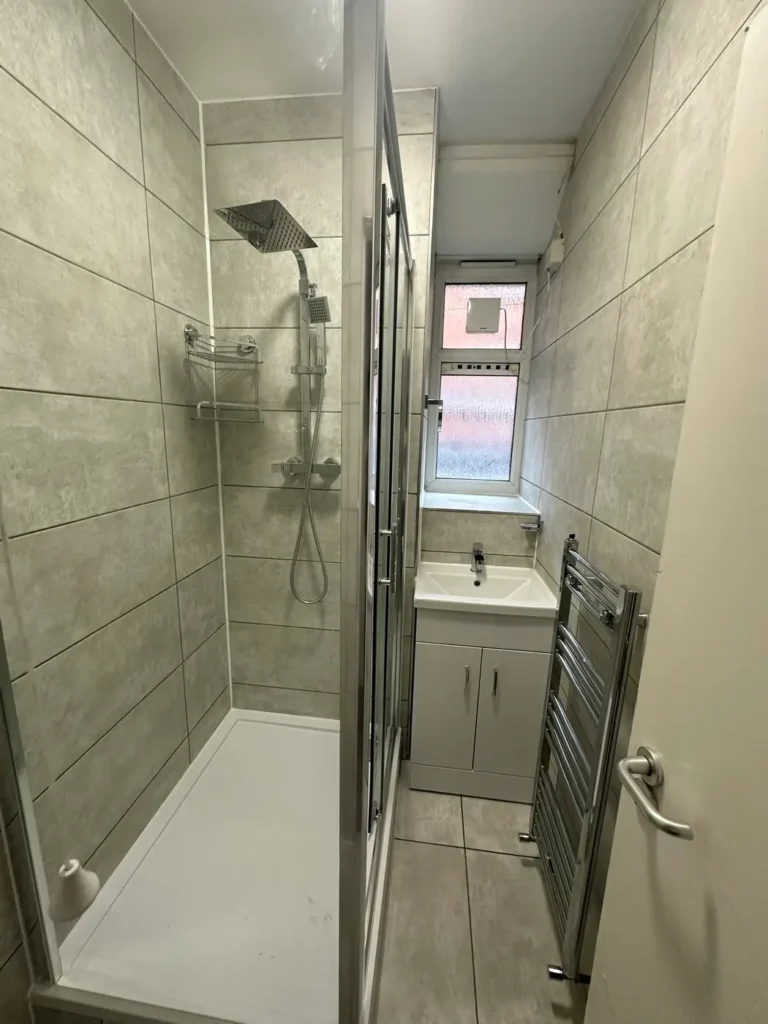
Real Soraiz Builders jobs in Hackney, documented from the dated photos taken on site.
Why Hackney Homeowners Choose Soraiz Builders
Soraiz Builders & Services Ltd was founded in 2019 by Shamraiz Hussain and has completed 250+ projects across all 32 London boroughs. On a Hackney job, that means checking conservation area status against all 36 designated areas, understanding whether a property is a standard terrace or a converted warehouse unit, and designing around Hackney's actual ground conditions rather than generic London Clay assumptions.
- 5.0 stars from 23 verified reviews on MyBuilder
- Fixed-price contracts as standard, no day-rate creep
- Founded 2019, 250+ completed projects across Greater London
- WhatsApp us directly on +44 7424 518632
- Free site visit, written quote within 2 hours
Frequently Asked Questions
Answers to the questions homeowners in this area ask most.
Do I need planning permission for an extension in Hackney?
It depends on the property. Hackney has 36 conservation areas, more than almost any other London borough, and if your property is inside one, planning permission is usually needed for extensions and roof changes. Outside a conservation area, many rear extensions within normal limits keep permitted development rights. We check your exact status before recommending a route.
Is my street in a Hackney conservation area?
Hackney has 36 conservation areas, including De Beauvoir, Broadway Market, Stoke Newington, Clapton Square and Victoria Park. Check your exact address on Hackney Council's planning portal, or ask us to check it as part of a free quote.
Why is Hackney's ground different from the rest of London?
Most of London sits on London Clay at the surface. Hackney mostly doesn't. The borough sits on Hackney Gravel and brickearth over the clay, which is a different structural profile and needs different foundation and extension design. We check ground conditions properly rather than assuming standard London Clay advice applies.
What's different about renovating a converted warehouse in Hackney Wick?
Converted warehouse and live-work units often have solid walls with no cavity, original cast-iron columns or steel beams that can't be cut into freely, and a shared freehold with other units that adds a layer of consent beyond a normal terrace extension. We treat these as a distinct category of job, not a flat that happens to be in an old building.
Do I need a Party Wall Agreement for building work in Hackney?
Very likely on a Victorian terrace, since most extension or loft work falls within 3 metres of a neighbouring property. Converted warehouse units can be more complex again, often needing consent from a shared freeholder or management company as well. We handle this as part of the project rather than leaving it until after planning permission is granted.
Which parts of Hackney do you cover?
We cover the full London Borough of Hackney, including Dalston, Stoke Newington, London Fields, Clapton, De Beauvoir Town, Hackney Central and Hackney Wick, postcodes E5, E8, E9, E20, N1 and N16.
What's different about renovating a warehouse conversion in Hackney Wick?
A Hackney Wick or Shoreditch conversion often has original cast-iron columns and steel beams that can't simply be cut into, a shared freehold with other converted units, and often no cavity wall at all, just solid brick or concrete. We treat this as its own category of job, not a flat that happens to be in an old building.
Why is Hackney's ground different from most of London?
Most of London's subsidence stories involve London Clay shrinking and swelling with the seasons, but Hackney sits on Hackney Gravel and brickearth over the clay rather than the clay itself being at the surface. Brickearth can be firm in one spot and prone to sudden settlement elsewhere, so ground investigation matters more here than a standard London Clay assumption would suggest.
What is Sutton House?
Sutton House in Homerton, near Mare Street and the Hackney Empire, dates from 1535 and is the oldest surviving house in the borough. It sits within the historic centre of Hackney, an area with a long history that predates the borough's Victorian expansion.
Does living near the canal in Hackney Wick cause any building issues?
Properties close to the Regent's Canal or the River Lea in Hackney Wick occasionally raise drainage and damp questions that inland Hackney properties don't have. It's worth checking rather than assuming, particularly for any ground-floor or basement-adjacent work near the water.
Do converted warehouse flats in Hackney need a different Party Wall approach?
Yes, often. Victorian terraces need a standard Party Wall Agreement for most rear extensions, but converted warehouse units in Hackney Wick or Shoreditch often share a freehold or management company with several other flats, which adds a layer of consent that a straightforward terrace extension doesn't need.
Other London Boroughs We Also Cover
Borders Hackney to the west, towards Highbury and Canonbury.
Borders Hackney to the north, towards Harringay and Stoke Newington's northern edge.
Borders Hackney to the north east, towards Clapton and Walthamstow Marshes.
Borders Hackney to the east, towards Hackney Wick and Stratford.
Get a Free Quote in Hackney
Whether you're near Sutton House, Homerton High Street, E9 or elsewhere in Hackney, Soraiz Builders provides building and renovation services throughout Greater London. A written quote follows within 2 hours.